Hanging With Ward–May, 2023–Day 3–On The Road

At the end of the last episode in this series I was sacked out in my car 18 miles down the Hole In The Rock road, while Kerry and Big Nate were camped along a bend in the Escalante River about 9.3 river miles downstream from their put in point the day before. It is now Friday, May 12, at the beginning of the day.

Down on the river, by 10 am Nate and Kerry were up, about, and getting ready to continue on their adventure. Boats had been reorganized and pumped up.

Friday morning, ready to shove off

While the bulk of Kerry and Nate’s adventure involved floating down a long river, I was off on an adventure of my own. I had gotten up early, driven back to Escalante for espresso and breakfast, and was on the road doing what I love to do–driving.

View of the put in location from UT-12. From here the road descends, crosses the river, and rises along Calf Creek Canyon on the other side

The plan for the day was to investigate Capitol Reef National Park. Capitol Reef is a 75 mile drive north of Escalante along Utah Scenic Byway 12, aka UT-12, an incredibly scenic road through some of the least traveled parts of the country. I was on the road by 10 am, heading north on UT-12 from Escalante toward Boulder. The first scenic part of the road winds its way along an escarpment about the upper Escalante River with lots of curves, vistas, and steep descents and climbs.

The most awesome section is called the Hogback. For several miles the road is on the top of the ridge separating the Escalante River and one of its main tributaries, Boulder Creek. There is a steep drop off on each side down into their respective canyons. Someday I want to get set up to capture video on my drives, and this road would be the first I would I would want to capture.

Shortly before Boulder there is a Forest Service Road named Hell’s Backbone that joins from the left. There is a loop drive from Escalante that goes due north into the Dixie National Forest and then connects back to UT-12 via the Hell’s Backbone route. I had hoped to do that on my trip in this year, but the change in focus from Escalante to San Rafael nixed that!
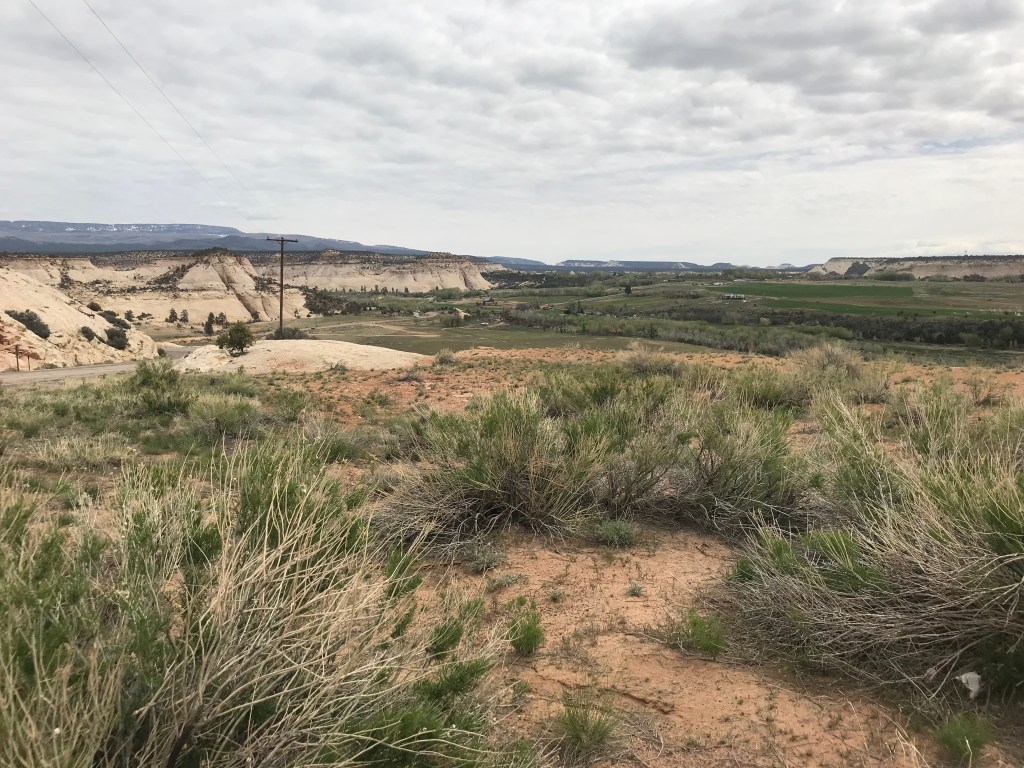
Looking down on Boulder Creek where it descends from Boulder Mountain into Boulder

Boulder is the only town in the 55 mile stretch between Escalante and Grover. It is the most remote town in the contiguous United States and did not even have a paved road or electricity until 1947. It is a farming and ranching community that sits at the base of Boulder Mountain. That mountain is the source of the bulk of the water that flows down the Escalante. Boulder Mountain has a very flat summit with over 70 square miles of land above 11,000 feet, and it is snowmelt from this plateau that feeds the Escalante in the spring/summer.
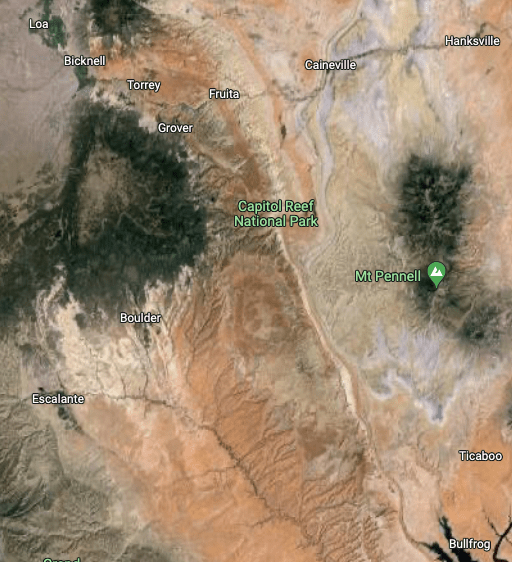
The area that I explored on this trip

From Boulder the road goes over the shoulder of Boulder Mountain through the Dixie National Forest. There are some nice growths of lodgepole pines along the road, and on the east there are vistas of the Henry Mountains and the Waterpocket Fold. The Henry Mountains were the last mountain range in the lower 48 states to be mapped and surveyed.
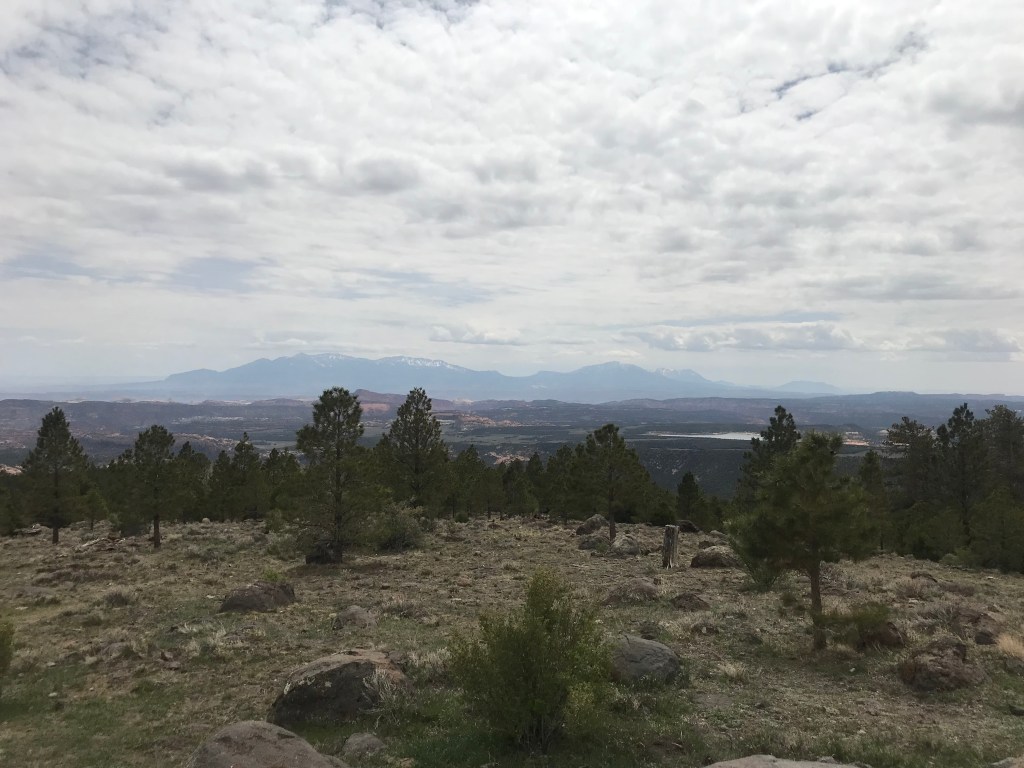
Henry Mountains from UT-12. Mt. Pennell is about 26 miles away as the crow flies, or about 100 if you go by car.

Meanwhile, down on the river Kerry and Nate were making good progress. Here is Nate entering a bit of a rapids.

It’s all about the setup when encountering obstacles

Once Nate got his raft straightened out it was smooth sailing.

The right line makes all the difference

Back on the road, about noon after about 65 miles I reached Torrey at the intersection of UT-24. UT-12 terminates here, and UT-24 is the main east-west artery in this part of Utah. Torrey is the gateway to Capitol Reef National Park if one comes from the west as UT-24 provides access to I-70 at Richfield. On the east the route goes to Hanksville where it turns north to join I-70 a few miles west of Green River. There is a route to the north that would use UT-72 from Loa to I-70 for what looks like an incredibly scenic 40 mile drive. Maybe next time!!

The Visitor Center for Capitol Reef National Park is about 11 miles east of Torrey. The road takes you along an escarpment that is a feature of the Waterpocket Fold. The WF is a geologic feature caused by a wrinkle in the earth that runs from Lake Powell in the south to about 8 miles north of Torrey. For once, I did remember to stop and get photos of some of the prominent features along the road.

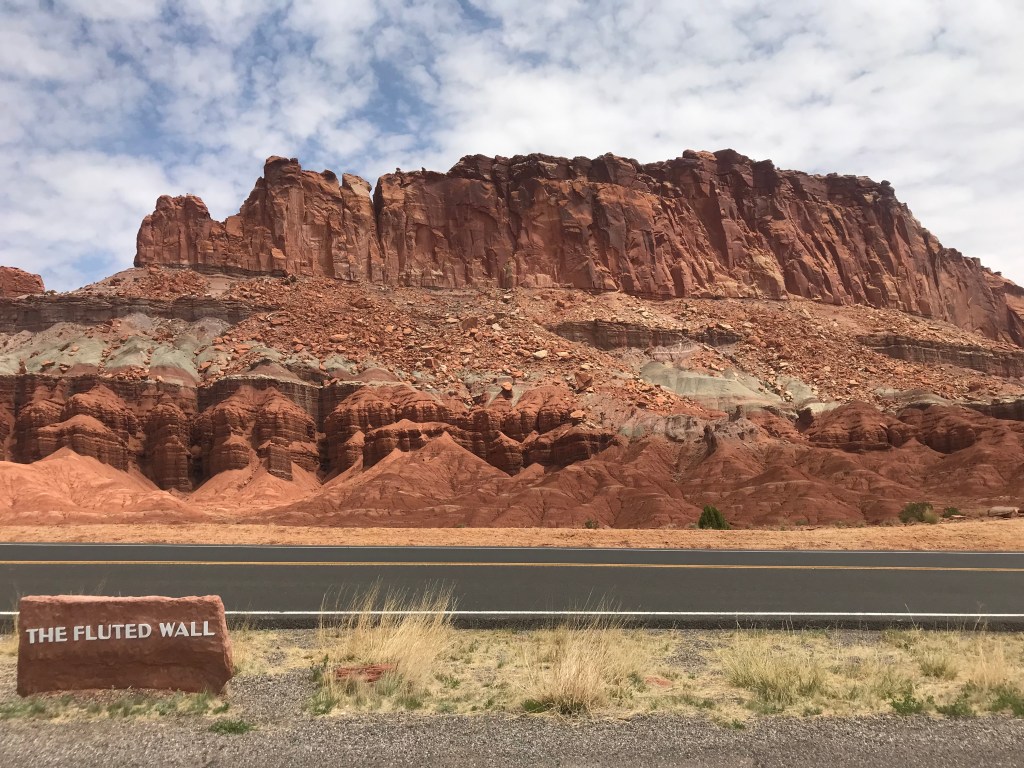
CRNP is a long and skinny park that runs from north of Torrey about 80 miles down to Lake Powell. The main tourist accessible feature is the Scenic Drive that turns off of UT-24. Not very long, at only 8 miles, but very scenic. The road runs along the west side of the WF with access to a number of slot canyons that descend from the fold. My hiking abilities were severely limited, but I did stop at the ultimate point, The Golden Throne trailhead, for a very brief sojourn.

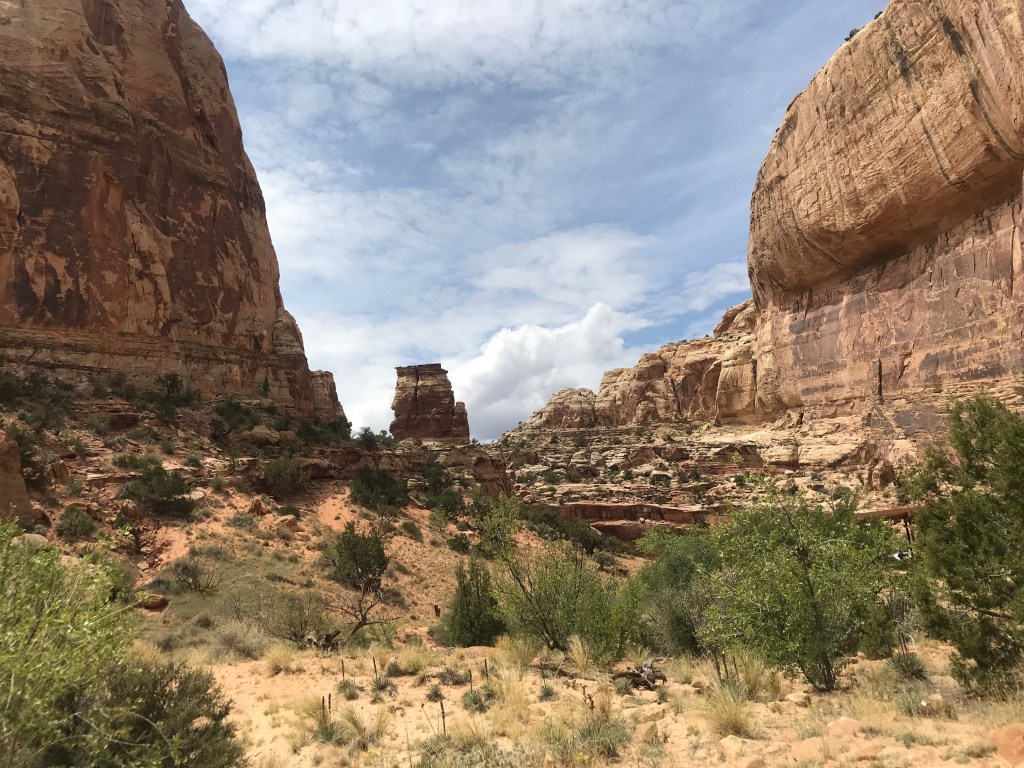
I returned to UT-24 and continued east. The road crosses the widest portion of the park, and in the 30 miles from Torrey to Caineville you can see the transition from the uplands west of the park to the deserts to the east as the road follows the Fremont River. The Fremont runs from the FishLake National Forest along UT-24, across the Waterpocket Fold, and joins up with Muddy Creek near Hanksville to form the Dirty Devil River.

While I was enroute from Torrey to Hanksville, Kerry and Nate were having more adventures on the river. There is no way they could carry enough water to last four days, so they could either use their water filters to pump potable water, or take advantage of many springs that can be found along the way.

Fresh water from a spring

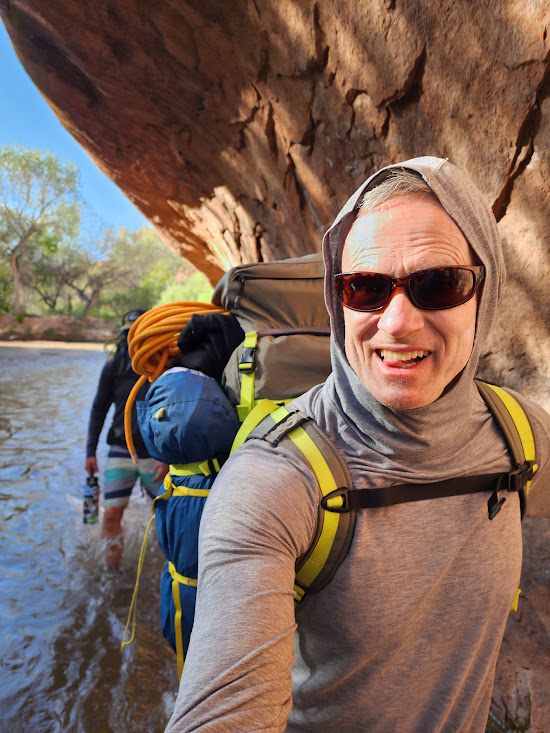
It wasn’t always smooth sailing! While the river flow was pretty good, there were still numerous spots where they had to leave their boats.

Nate gets hung up

For this blog I am working from the media that Kerry and Nate captured on the trip, but unfortunately the files I have don’t have any location information. As a result, it is hard for me to determine where they are. Here Kerry gives a clue about how far downriver they have come while on a side exploration.

One must keep an eye on the weather when running a river as a heavy rainfall somewhere upstream can have serious consequences in a narrow canyon.

What if it rains?

Having read a lot of Edward Abbey the name Hanksville stood out for me, so I continued east on UT-24 until I got to Hanksville about the same time that Nate and Kerry were being rained on. I stopped to eat some Mexican food at a restaurant called the Outlaw’s Roost, and from the porch I captured a nice view of the Henry Mountains.
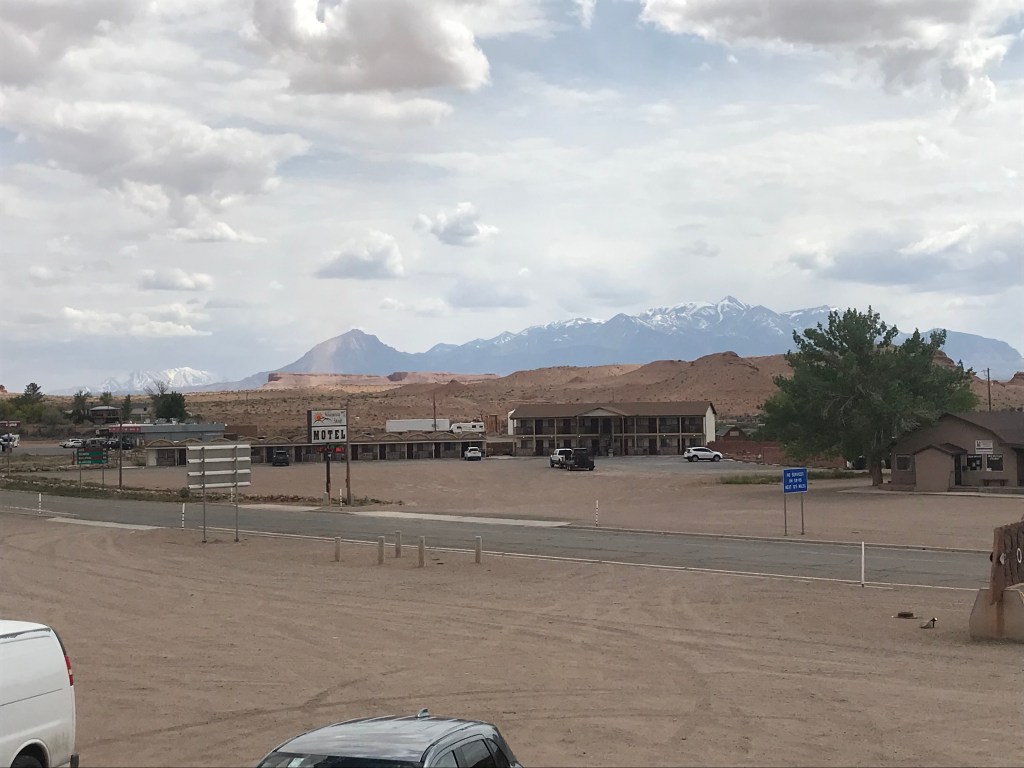
The Henry Mountains from the Outlaw’s Roost in Hanksville

I wanted to find a coffee shop where I could sit, read, and check my correspondence, but even a cell phone signal was difficult to find. I drove back to Torrey where I could at least get a signal and started to look for some place to stay for the night. Camping options are very limited in the National Parks, but there are many opportunities to camp in the National Forests, so I searched for dispersed camping areas in the FishLake National Forest. I identified a likely location that was about 30 miles away, so I made my way there passing through the small towns of Bicknell, Lyman, Loa, and Fremont.

While I was driving to Fishlake National Forest, there were some significant developments on the river. Here they meet some fellow travelers!

Fellow travelers

Here is one of the significant hazards that will be encountered on a rafting trip.

Watch that head!

Up until this point there have not been much in the way of identifiable landmarks that I can use to identify their position. One big help is to identify the places where creeks join the river. Here they have gotten to Silver Falls Creek! The various tributaries have their own canyons that are great targets for exploration, and the creek mouths create excellent camping sites.

Silver Falls Creek

In the map below the put in location is marked in blue at the top left, and the confluence with Silver Falls Creek is at the bottom right. The straight line distance between those point is about 15.6 miles, but the river distance is on the order of 35-40 miles. There is nothing straight ahead about a canyon here.

Travels on river days one and two

Rather than camping at Silver Falls Creek, Nate and Kerry pushed on down river for another hour and met up with some friends.

Meeting friends along the way

Mari’s husband Tom is one of Kerry’s partners in Full Tilt Team Development, and the two of them have done a lot of “hanging with Ward” over the years. They have done things like riding out a thunder storm at Reflection Canyon, descending slot canyons in Zion, rafting the Grand Canyon, and traveling to Everest Base Camp to name just a few. Both Mari and Tom have been featured in a number of Kerry’s YouTube videos. Meeting up with her means it’s time for shenanigans!
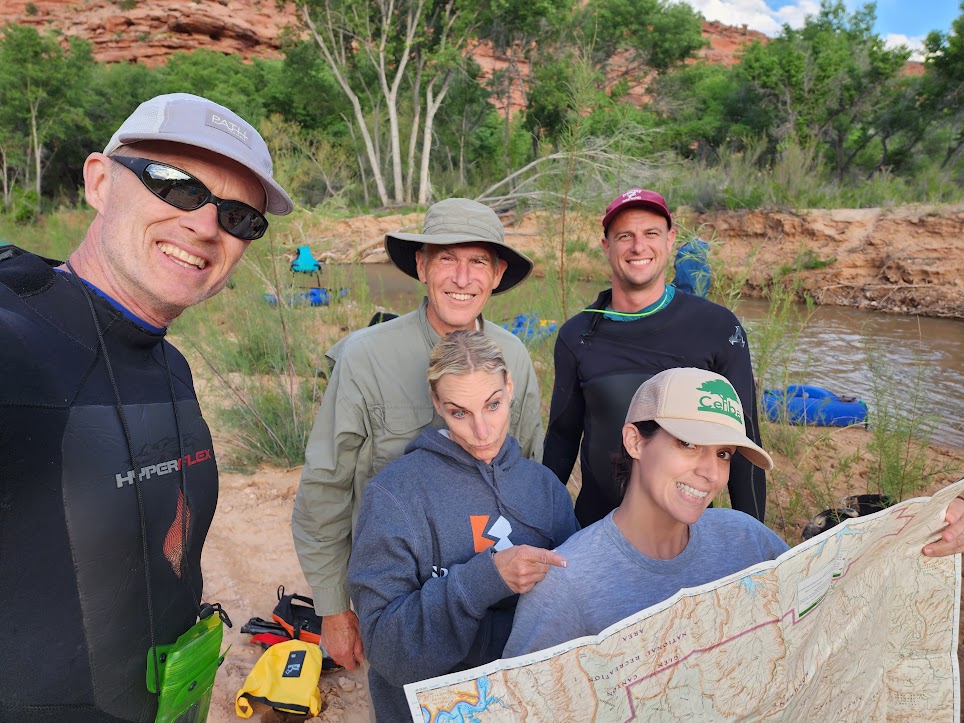
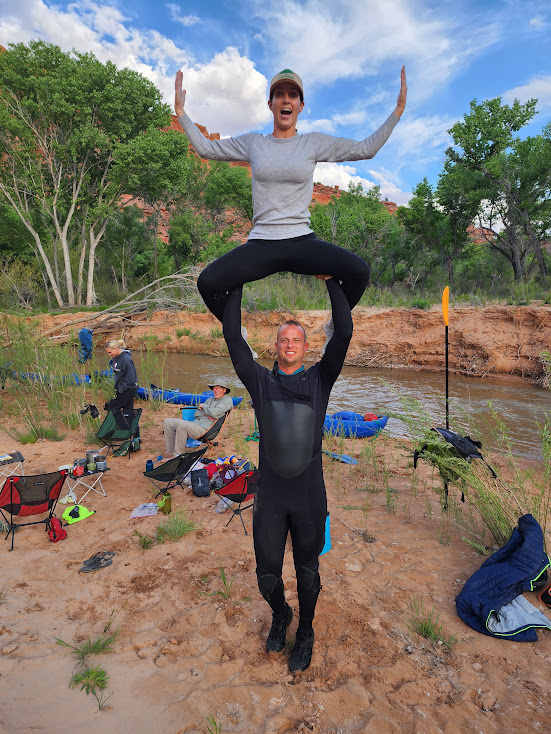
Kerry had a big mileage target for the day, so he decided to keep on down the river to take advantage of the remaining daylight. Finally, after about 29 river miles they set up camp in sight of one of their prime objectives, Neon and Chop Rock canyons.

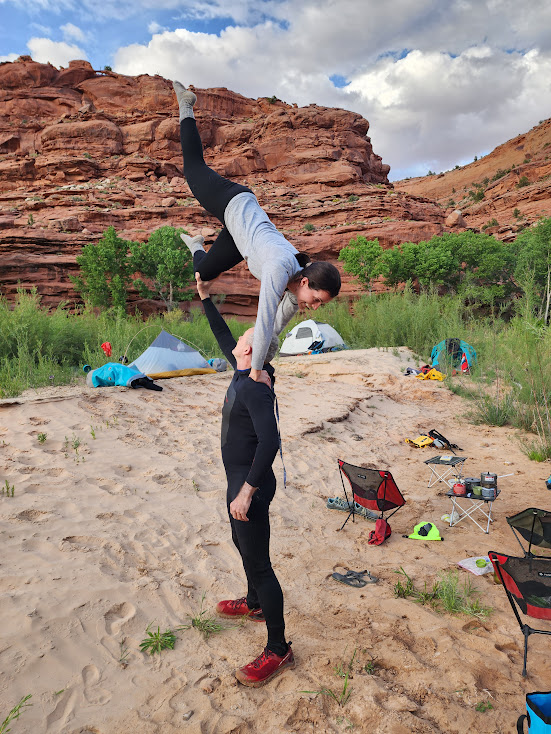
Second night campsite, the morning after

About the same time that Kerry and Nate were settling in for the night I had also reached my destination for the night, a campsite along the Fremont River in the Fishlake National Forest.

At one point just past Fremont there was a road closed sign, but I ignored it and continued on until I reached a very nice campsite along the Fremont River. I opted once again to sleep in my car rather than set up my tent. In retrospect that was a prudent decision. I had been puzzled by the road closure, but as it started to rain I realized that the low area next to the river was a prime location for flash flooding.

Can there be too much river access?

Given how much it rained overnight I was very happy that I had opted to sleep in my car in a lot that was several feet above the river!
Hanging With Ward–May, 2024–ChopRock

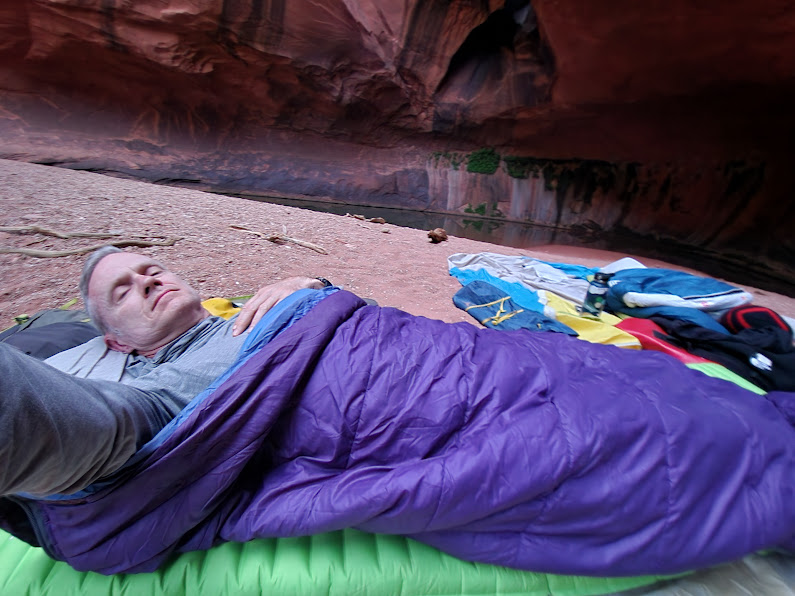
When we last left our intrepid adventurers they had successfully descended the technical portion of Neon Canyon and landed in the pool in the Golden Cathedral. Wet gear was hung out to dry. Chris Hardwick slept in his tent, sans rainfly, while Kerry and Max camped cowboy style on the sand. By 6 am there had already been signs of life. Gear had dried and the morning light was flooding the Golden Cathedral.

Golden Cathedral in the Morning

The three amigos, Kerry Ward, Chris Hardwick, and Max Simmons readied themselves for a challenging day. Kerry needs no introduction here, but some attention to his companions is warranted as they both have pretty extensive shared histories with Kerry.

Chris Hardwick is an Australian entrepreneur and adventurer currently living in Vancouver, CA. Chris owns a Land Cruiser named Thor that he keeps in Africa. He and Kerry spent a month last year driving Thor around the southwest of Africa and will be exploring east Africa in Thor this July.

Max Simmons is easily Kerry’s oldest friend. They were born within months of each other in India where their parents were doing work related to public health. Their parents are great friends and the families have maintained close connections over the years, doing things like vacationing together. When Kerry was spending his formative years in East Lansing Max was living in Ann Arbor and would often make the 60 mile trip to Lansing to hang out with Kerry at places like Pinball Pete’s.

Three Amigos–Chris, Kerry, and Max

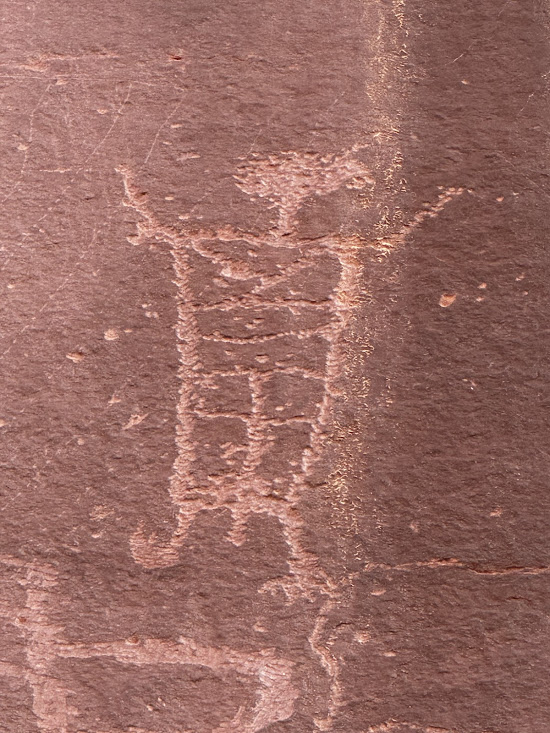
There is a large rock wall near the Golden Cathedral that has a lot of petroglyphs, or artwork etched into the stone. Some of it was created by indigenous people from time immemorial, but there is also a lot that is of more recent provenance. Think of it like a big, stone bathroom wall.

The objective for the day was going to provide a peak adventure experience for the three amigos. There are certain constants when hanging with Ward. If there is a high place, he is up there; if there is Boba place he wants some; if there is a hot spring, he is in it. He is exceptionally attracted to slot canyons, the more difficult the better. In 2018 I was crew when he, Kerry Sherman, and Sam Edwards descended the very challenging Heaps Canyon, and the target of the day, ChopRock, promised significant problems to untangle.

According to Canyoneering USA, “It is a nice one, one of the best. It can be very difficult, and should always be taken seriously. It is not a place for “Youth Groups”, college outing club adventure hikers, or “experienced outdoorsmen”. It is a place for experienced canyoneers.” There is a certain body of knowledge required to safely descend slot canyons. Proficiency at using climbing harnesses and rigging anchors for rappels is essential. There are places where rushing water has carved out deep potholes (keepers) that may be filled with water, so the canyoneer must know how to deal with them. Narrow spots may be clogged with debris making every descent different from those that came before. Teamwork is essential to make it through, and while the Three Amigos are a pretty small team they rank high on that teamwork index.

Shortly after 8 am they made their way out of Neon Canyon and began wading up the Escalante to the mouth of ChopRock. Near the mouth of the canyon they followed a trail taking them up to the table lands above the canyon. By 9:30 they were well above the canyon and the serious route finding began.

The table lands above and between the canyons alternate between slickrock, or bare rock surfaces, and pockets of sparse soil. In a very lightly traveled region like that leading to a difficult canyon like ChopRock trails are largely nonexistent or very sparsely marked. Kerry is very adept at negotiating such a landscape as I saw first hand when Kerry, Tom and Mari Seletos, and I took a memorable trip to Rainbow Canyon in this area several years ago. You can find Kerry’s video on that trip here.

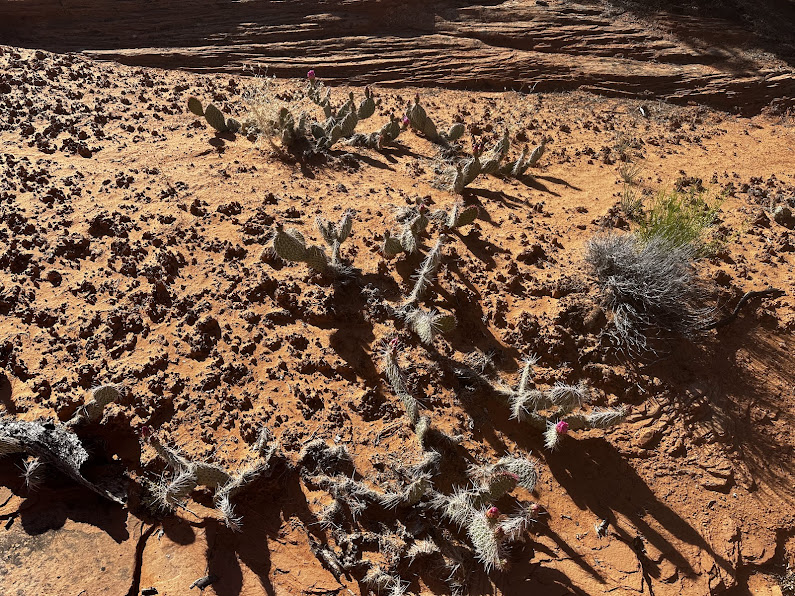
Cryptobiotic soil with plants

Much of of the area between bare rock supports something called cryptobiotic soil. Our planet is always changing, and bare rock ultimately weathers, erodes, and is transformed into barren soil. That barren soil is then transformed into biologial soil through the actions of cyanobacteria, algae, and fungi. According to the NPS, “Biological soil crusts, sometimes called cryptobiotic soil crusts, are an important part of arid and semi-arid ecosystems throughout the world, including those in Glen Canyon National Recreation Area”. The preservation of those crusts is of paramount importance, so it is important for travelers to stick to established trails and to avoid disturbing these patches.

By about 10:20 they had identified their slot canyon target below them and were looking for a way down to it.

On the table lands and looking below for the target canyon

They picked their way down to the slickrock along the canyon rim looking for an access point where they could make their way down to the bottom of the slot

On the slickrock above the slot and looking for a way down

By about 11:40 they had identified a point where they could scramble down to the bottom of the canyon. It wasn’t long before they came to their first rappel and immersion in water.

In this type of canyon there will be places where you need go go down but can’t even see the bottom. In the video below Max takes a leap of faith while praying that the rope is long enough to get him down safely.

Where did he go??

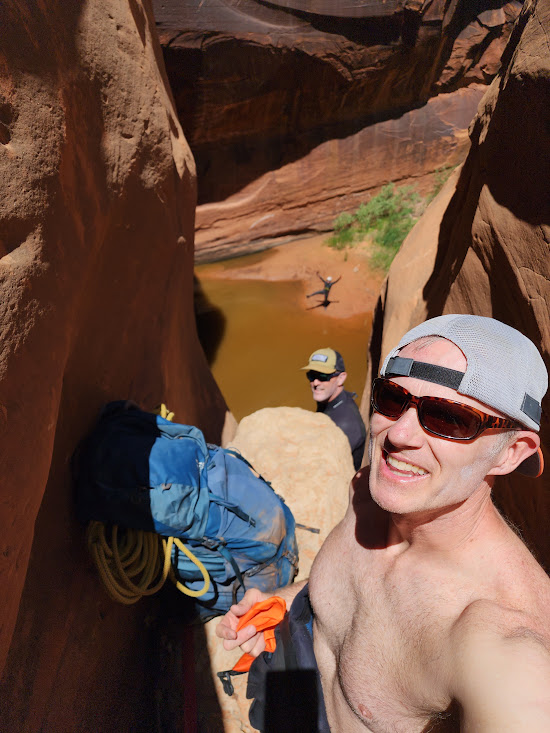
Max did indeed find the bottom and Chris and and Kerry joined him shortly. Shortly after 1 pm they had another opportunity to rappel down into a lake. In canyoneering even entering into the rappel can be challenging.

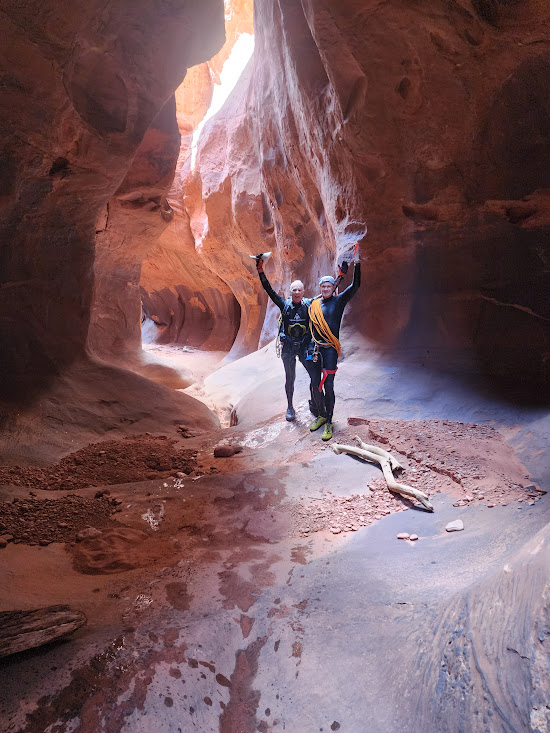
The article on ChopRock in the Canyoneering USA broke the canyon down into different sections, and the slideshow below has some sights from the segment that was characterized as the “Happy Section”. According to the article, “The Happy Section alternates long cold swims with nice walking through slots, plus a couple of downclimbs.”

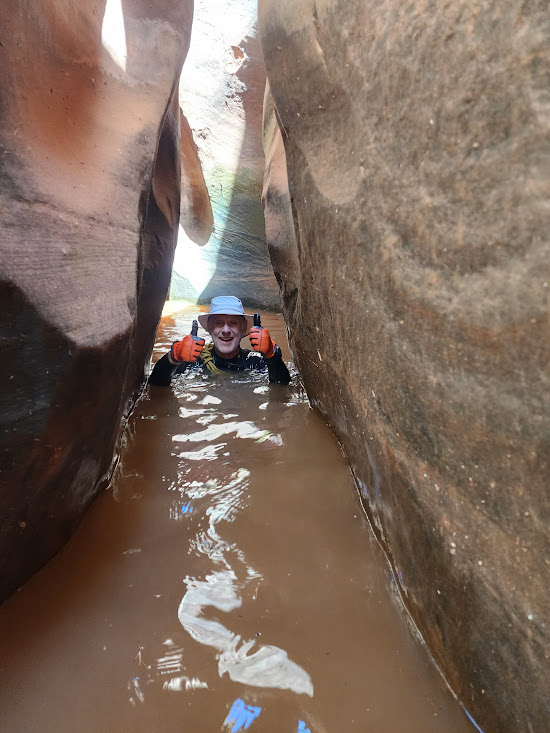
Happiness doesn’t last forever, however, and pretty soon they were into the “Grim Section” with some long swims and very tight squeezes. This is not a canyon for people with large frames!

Canyoneering is not recommended for anyone who suffers from claustrophobia. Also not for the portly among us! Kerry has a very slim build, and even he was squeezed on occasion.

Wetsuits are essential for this type of escapade. Part of the mystique of ChopRock stems from the fact that in May of 2005 a pair of young men attempted the canyon without proper equipment and wound up dying from hypothermia. Depending on water levels there may be many hours of swimming required.

The Three Amigos posted a lot of pictures and videos early in this adventure, but the volume of media dropped off sharply as they traversed the Grim section. It’s kind of hard to get out the camera when one is swimming through a long section trying to keep the gear bag high and dry.

There is a goodly amount of problem solving required to get through some of the tight spaces. There may even be sections where the bottom of the canyon may not be too narrow to afford passage and it is necessary to do things like go over an obstacle.

Problem solving and cooperation are essential
Through the labyrinth

Near the end of the slot portion Max sustained an injury to his hand. On one of those difficult entries to a rappel he got his hand caught between the rope and a rock. If injured there is nothing much one can do besides soldier on. There is no backing out once you have descended into the depths of the canyon. Max did violate one of the precepts of responsible wilderness travel by leaving something behind, but I think the wilderness will recover!

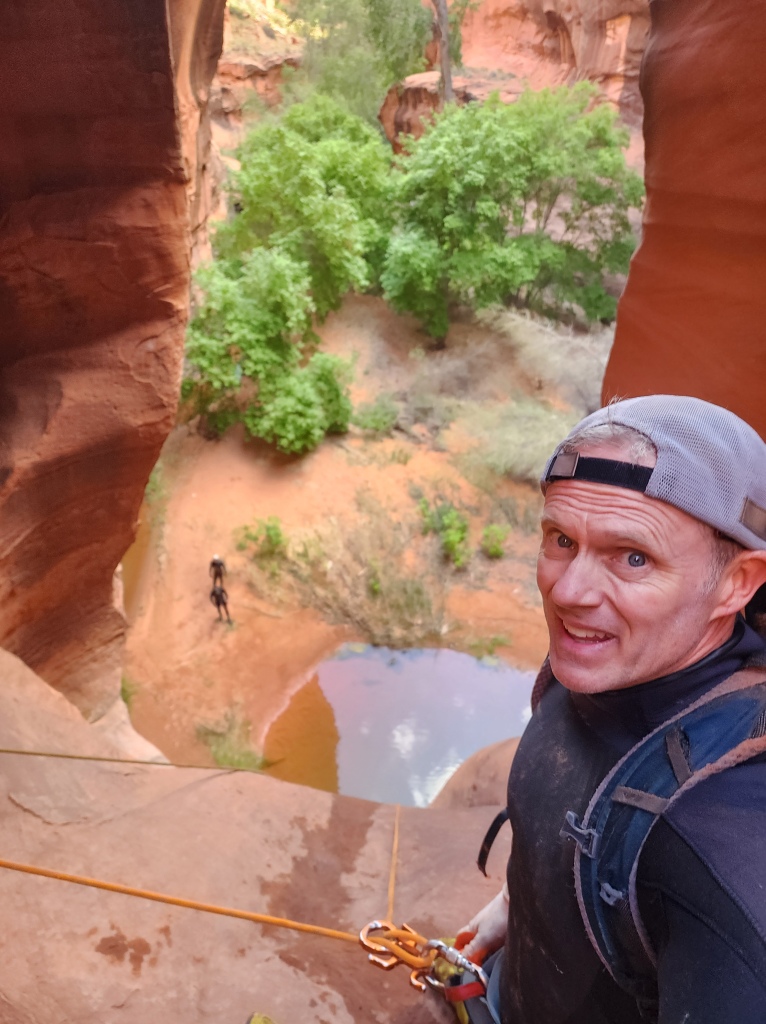
Finally, the end of the slot portion was in sight. It is quite common for these slot canyons to end as hanging canyons requiring a significant rappel that is one of the highlights of a slot canyon descent. The final rappel at ChopRock pales in comparison to the 300 foot exit from Heaps Canyon, but a 90 foot drop is nothing to sneer at.

Last one down
It’s always cool when you can do a spider drop into a pool of water for the finale!

Once down it was an easy walk down the canyon back to the Escalante River. Kerry was able to send me a message just before 6:30 predicting that they would be back at the Egypt trailhead shortly after 9 pm.